 By
Kelley Kelly
By
Kelley Kelly
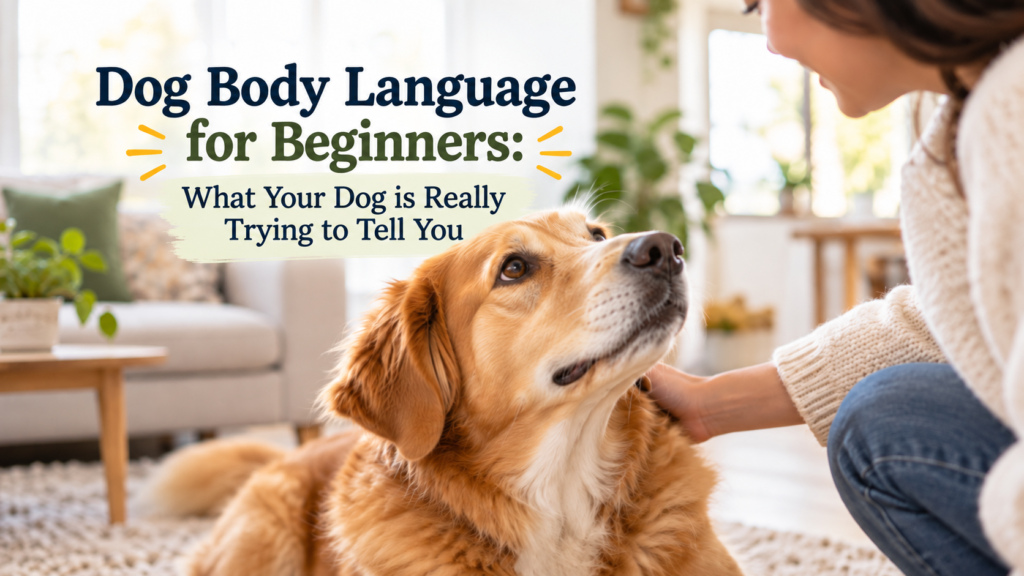
Bringing a dog into your home is joyful, but it can also feel a little mysterious. Your dog cannot sit across from you and explain that the visitor at the door feels overwhelming, that the toddler reaching for their collar is making them nervous, or that the loud park was simply too much for one afternoon. Instead, your dog speaks with their body. Their eyes soften or widen. Their tail rises, lowers, stiffens, or loosens. Their mouth opens in a relaxed pant or closes tightly. Their weight shifts forward, backward, or away from something they do not trust.
Learning dog body language is one of the most important skills a new dog owner can develop. It helps you recognize stress signals in dogs before they turn into barking, jumping, growling, snapping, hiding, or destructive behavior. It also helps you notice when your dog is comfortable, playful, curious, tired, overstimulated, fearful, or asking for space. That awareness can make daily life calmer and safer for everyone in the home.
The key is to stop reading one body part in isolation. A wagging tail does not always mean a happy dog. A yawn does not always mean a sleepy dog. A growl does not mean your dog is bad. Canine communication works best when you look at the whole picture, including the dog’s face, posture, movement, tail, ears, mouth, eyes, and the situation happening around them. Veterinary and behavior sources consistently emphasize context because the same signal can mean different things depending on what the dog is experiencing at that moment. ASPCA Pro notes that teeth, tail movement, ears, eyes, and posture must be read together, not separately, to understand what a dog is communicating.
Why Dog Body Language Matters So Much
Dog behavior rarely comes out of nowhere. What looks sudden to a human often had several warning signs first. A dog may lick their lips, turn their head away, hold their body stiff, tuck their tail, show whale eye, freeze, or move behind their owner long before they bark or growl. Many owners miss these early cues because they are subtle, quick, and easy to mistake for ordinary behavior.
This matters because body language gives you time to help. When you notice your dog becoming uncomfortable, you can create space, lower excitement, end an interaction, redirect calmly, or remove your dog from a situation that is too intense. That is very different from waiting until your dog is already barking, lunging, or snapping. At that point, your dog may be over threshold, which means their emotional arousal is so high that learning, listening, and self control become much harder.
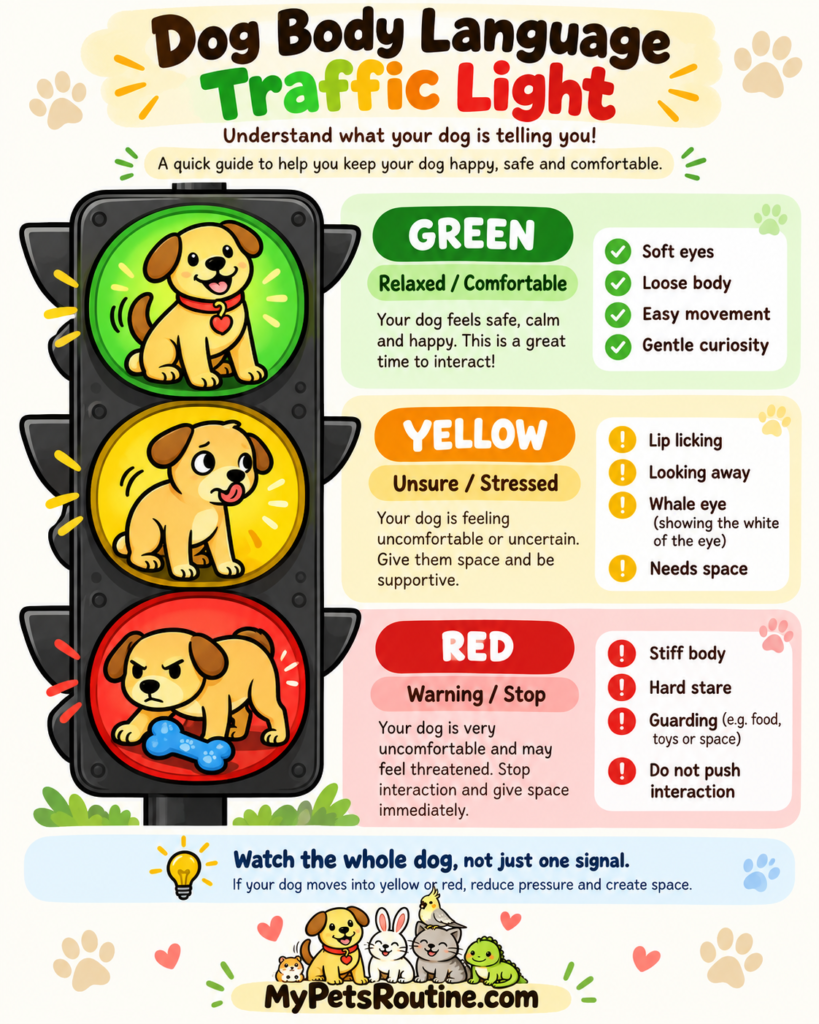
A beginner friendly way to think about dog communication is to imagine a traffic light. Green signals usually suggest comfort. Yellow signals suggest stress, uncertainty, arousal, or a need for support. Red signals mean you should stop what is happening and give the dog space immediately.
Relaxed Dog Body Language: What Comfort Looks Like
A relaxed dog usually looks soft. That may sound simple, but softness is one of the best words for reading a comfortable dog. The eyes may appear almond shaped or gently squinty rather than wide and round. The mouth may be open without tension. The body may look loose, wiggly, or naturally balanced. The tail is often held in a neutral position for that individual dog, moving in a broad and easy way if the dog is happy to engage.
AVSAB describes relaxed dogs as often having almond shaped or squinted eyes, an open mouth, and softened body tone, while more nervous or defensive dogs tend to show rounder eyes, a closed mouth, pinned or sharply forward ears, and increased stiffness. This distinction is important because new owners often look only at whether a dog is moving toward them. A dog may approach because they are curious, but they may also approach while tense, conflicted, or unsure.
Comfortable posture is usually balanced. A relaxed dog is not shrinking away, leaning forward intensely, freezing in place, or trying to make themselves look bigger. Their movement has rhythm. They can sniff, look around, take food, respond to their name, and recover easily after a sound or interruption. In a home setting, a relaxed dog may lie on their side, stretch out, sigh, chew calmly, or rest near the family without constantly popping up to react.
A realistic photo that would work well here would show a dog resting on a living room rug with soft eyes, a loose jaw, and a neutral tail position. The alt text could read, “Relaxed dog body language with soft eyes, loose posture, and calm expression.”
The Tail Is Only One Part of the Story
Many people are taught that a wagging tail means a friendly dog. That belief can create problems because tail movement often shows arousal, not simply happiness. A dog can wag when they are joyful, but they can also wag when they are tense, conflicted, frustrated, or ready to react. ASPCA Pro explains that relaxed dogs often show a loose, wide tail wag, while a tail held high with short, stiff, rapid movement can indicate tension, high arousal, or potential aggression.
The best question is not, “Is the tail wagging?” The better question is, “What is the whole dog doing?” A loose body, soft eyes, relaxed mouth, and sweeping tail usually tell a different story than a stiff body, hard stare, closed mouth, and high vibrating tail. The tail is useful, but it is never the entire sentence.
Stress Signals in Dogs: The Quiet Warnings Owners Often Miss
Stress signals in dogs can be surprisingly small. Your dog may lick their lips when no food is present. They may yawn even though they are not tired. They may turn their head away, avoid eye contact, blink rapidly, pace, hide, sniff the ground suddenly, shake off when they are not wet, tuck their tail, or press their ears back. These are not signs of stubbornness. They are communication.
ASPCA Pro identifies yawning and lip licking as early stress signs, especially when they appear with a tight mouth and averted gaze. VCA Animal Hospitals also notes that stressed dogs may pace, shake, whine, bark, yawn, drool, lick excessively, show more white around the eyes, pin their ears back, tuck their tails, become rigid, pant without exercise, hide, or avoid interaction.
This does not mean every yawn is a crisis. Dogs yawn when they are sleepy, lick their lips when they smell food, and pant when they are warm. Context matters. A yawn during a nap is ordinary. A big repeated yawn while a child hugs the dog around the neck is different. A lip lick after dinner is normal. A lip lick when a stranger leans over the dog’s head may be a request for space.
Whale Eye: When the Whites of the Eyes Tell a Story
Whale eye happens when a dog turns their head slightly away but keeps their eyes fixed on something, causing the white part of the eye to show. It is often a sign that the dog feels anxious, pressured, or uncomfortable. Some breeds naturally show more eye white because of their facial structure, so again, the whole body matters. Whale eye paired with stiffness, a closed mouth, tucked tail, pinned ears, or guarding behavior deserves attention.
When you see whale eye, do not move closer to test the dog. Do not reach over them. Do not take the object from their mouth by force. Instead, pause and ask what is making the dog uncomfortable. Are they cornered? Is someone leaning over them? Are they guarding food, a bone, a bed, or a toy? Are they being hugged or restrained? Your safest response is to reduce pressure and create distance.
A realistic picture for this section could show a dog looking sideways while resting near a chew toy, with visible white around the eye and a slightly tense face. The image should not be dramatic or frightening. It should teach subtle recognition. The alt text could read, “Dog showing whale eye as an early stress signal during a tense moment.”
Overexcitement Versus Happiness: Why Wild Behavior Is Not Always Joy
One of the most common misunderstandings new owners have is assuming that a highly animated dog is always a happy dog. Jumping, mouthing, barking, spinning, grabbing clothing, frantic zoomies, and rough play can look cheerful, especially in puppies and young dogs. Sometimes they are part of normal play. Other times, they mean the dog has tipped from happy excitement into overstimulation.
A truly happy dog can usually recover. They may play, pause, respond to cues, take treats gently, and settle after activity. An overstimulated dog often cannot slow themselves down. Their movements become faster, harder, and less thoughtful. They may jump at faces, bite sleeves, bark in a sharper tone, ignore familiar cues, grab at hands, or zoom through the house with no ability to pause. ASPCA Pro describes aroused dogs as potentially showing stiff bodies, rapid tense tail wagging, dilated pupils, panting, high pitched vocalization, poor impulse control, and excess energy expressed as jumping, nipping, grabbing, spinning, digging, or zoomies.
This is where daily routine matters. Many dogs do not need more chaos when they are overexcited. They need help coming down. That may mean a quiet potty break, a food puzzle, a chew, a short sniffing walk, a calm zone, or a predictable rest period. Overexcitement is not a moral failing. It is usually a regulation problem.
The Overstimulation Curve
| Stage | What It Looks Like | What Your Dog May Need |
|---|---|---|
| Comfortable engagement | The dog is interested, responsive, loose, and able to pause | Continue the activity while keeping the pace calm and positive |
| Rising arousal | The dog becomes faster, louder, bouncier, or more intense | Lower the energy before the dog loses self control |
| Overstimulation | The dog jumps, mouths, barks sharply, ignores cues, grabs, spins, or zooms frantically | Stop adding excitement and guide the dog toward decompression |
| Recovery | The dog sniffs, chews, drinks water, lies down, sighs, or rests | Protect the calm period so the nervous system can settle |
Warning Signs: When Your Dog Is Asking You to Stop
Warning signs are not bad behavior to crush. They are information. Growling, freezing, stiff posture, guarding, snarling, snapping, and hard staring are signs that your dog is no longer simply uncertain. They may feel threatened, trapped, protective, painful, afraid, or pushed beyond what they can handle.
ASPCA explains that aggressive behavior can include a sequence of warnings such as becoming very still and rigid, growling, showing teeth, snarling, snapping, and biting, although dogs do not always follow that sequence neatly. ASPCA also notes that many people miss warning signs before a bite and then believe the dog reacted without warning.
Freezing is especially important. A still dog is not necessarily a calm dog. If a dog suddenly becomes statue like while being touched, approached, hugged, or crowded, that stillness may be a serious warning. AVSAB identifies body stillness as a commonly overlooked part of canine communication and notes that stiff, uncomfortable dogs may escalate to growling, snapping, or biting if their signals are ignored.
Growling Is Communication, Not Disrespect
A growl can feel alarming, especially for a new owner. It is natural to feel embarrassed or worried when your dog growls at another dog, a visitor, a child, or even you. But growling is valuable communication. It tells you your dog is uncomfortable before they bite. Punishing the growl may stop the sound, but it does not fix the fear, pain, guarding, or stress underneath it.
The safer response is to calmly increase distance and identify the trigger. Did someone reach for the dog’s food bowl? Did another dog rush into their space? Did a child climb onto their bed? Did a visitor bend over them? Did the dog stiffen before the growl? Once the situation is safe, you can work on the underlying problem with reward based training, management, and professional support when necessary. AVSAB’s humane training position statement supports reward based methods and notes that aversive methods, which rely on force, pain, or emotional discomfort, should not be used in canine training or treatment of behavior disorders.
A realistic photo for this section could show a dog standing stiffly beside a food bowl while a human hand remains safely distant. The image should teach respect for space rather than dramatize aggression. The alt text could read, “Dog guarding food bowl with stiff posture as a warning sign to give space.”
How to Read the Whole Dog
The best way to read dog body language is to scan from nose to tail and then ask what changed. Look at the eyes. Are they soft, squinty, wide, hard, blinking, or showing white? Look at the mouth. Is it open and loose, tightly closed, panting rapidly, drooling, wrinkled, or pulled back? Look at the ears. Are they relaxed, pinned back, sharply forward, or moving in response to a trigger? Look at the body. Is it loose, curved, balanced, leaning away, leaning forward, crouched, stiff, or frozen? Look at the tail. Is it neutral, tucked, high and stiff, low and rigid, or loose and sweeping?
Then look at the environment. A dog licking their lips in the kitchen may be hoping for chicken. A dog licking their lips while a stranger reaches over their head may be stressed. A dog panting after a walk may be warm. A dog panting in a quiet room while hiding behind your legs may be anxious. VCA specifically recommends knowing your dog’s normal demeanor and paying attention to context so you can tell whether a behavior is ordinary or stress related.
Over time, you will learn your dog’s personal baseline. Some dogs naturally carry their tails high. Some have floppy ears that make ear position harder to read. Some breeds show more eye white. Some dogs are naturally bouncy, while others are reserved. Body language is not about memorizing a rigid dictionary. It is about noticing patterns and changes.
Common Situations Where Owners Miss Dog Stress
Many stress signals appear during ordinary family routines. A dog may look away or lick their lips when being hugged. They may freeze when a child climbs into their bed. They may tuck their tail when a guest bends over them. They may pace when visitors arrive. They may show whale eye when someone reaches for a stolen sock. They may bark wildly at the window because they are frustrated, not because they are having fun.
Handling is another common area of confusion. Dogs may tolerate nail trims, ear cleaning, brushing, harnessing, or being picked up while still showing signs of discomfort. If your dog repeatedly yawns, turns away, ducks their head, pulls their paws back, or becomes stiff during handling, they are telling you the process needs to be easier, slower, and more rewarding. Respecting those early signals can prevent future fear.
Dog parks and greetings also require careful observation. A loose, wiggly dog who curves their body and takes breaks is very different from a dog who charges straight in, stands tall, stares, pins another dog, or keeps chasing when the other dog tries to leave. Healthy play has pauses. It has role changes. It has loose bodies. When one dog keeps trying to disengage and the other keeps pushing, the interaction needs help.
What to Do When You Notice Yellow Zone Signals
When your dog enters the yellow zone, the goal is not to scold them into acting normal. The goal is to help them feel safer and calmer. Move farther away from the trigger. Stop the interaction. Give your dog room to sniff. Lower your voice. Let them retreat. Offer a familiar cue they can easily succeed with if they are still able to respond. Use food, distance, and calm movement to help the nervous system settle.
If your dog is still able to eat treats gently, respond to their name, sniff the ground, and move with you, you probably have a good opportunity to help them recover. If they cannot eat, cannot respond, cannot look away from the trigger, or are barking and lunging, they are likely too overwhelmed for training in that moment. They need distance first.
This is one of the kindest mindset shifts a dog owner can make. You are not giving in when you move your dog away from something stressful. You are preventing rehearsal of panic, barking, growling, or snapping. You are teaching your dog that you will listen before they have to escalate.
When to Get Professional Help
Some body language concerns deserve professional support. If your dog growls at household members, guards food or toys, snaps, bites, lunges at people or dogs, freezes during handling, panics when left alone, or seems suddenly more irritable than usual, it is wise to contact your veterinarian first. Pain and illness can change behavior. A dog with sore hips, dental disease, ear pain, skin irritation, or digestive discomfort may become defensive because touch or proximity hurts.
After medical concerns are considered, a qualified reward based trainer, certified behavior consultant, or veterinary behaviorist can help create a safe plan. This is especially important when children are involved, when bites have occurred, or when the dog’s warning signs are becoming more intense. Serious behavior concerns such as aggression, anxiety, and fear often require environmental management and behavior modification, and AVSAB notes that some cases may also involve medication as part of a treatment plan.
Building Trust by Listening Earlier
Your dog does not need you to be perfect. They need you to be observant, patient, and willing to listen. When you notice soft eyes, loose posture, and relaxed movement, you learn what comfort looks like. When you notice lip licking, yawning, whale eye, pacing, hiding, or a tucked tail, you learn when your dog needs support. When you respect growling, freezing, stiff posture, and guarding as serious communication, you reduce the chance that your dog will feel forced to escalate.
Dog body language is not just about preventing bites or stopping unwanted behavior. It is about building trust. A dog who feels heard is more likely to relax in your home, recover from stress, enjoy training, and look to you for guidance when the world feels confusing. For new dog owners, that is the heart of the lesson. Your dog is always talking. The more carefully you listen, the safer and more peaceful your life together becomes.