
 By
Kelley Kelly
By
Kelley Kelly
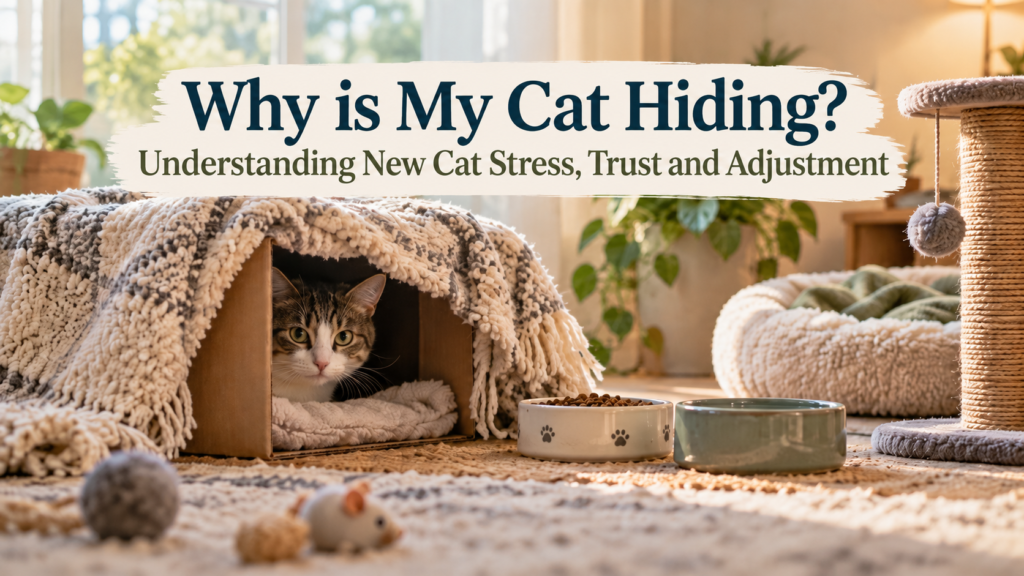
Bringing a new cat home can feel surprisingly emotional. You may have imagined your cat stepping out of the carrier, exploring the room, brushing against your legs, and settling into the family within hours. Instead, your new cat may disappear under the bed, behind the couch, inside a closet, or into the quietest corner they can find.
For a new cat owner, that can feel discouraging. It may even feel personal. You might wonder whether your cat dislikes you, whether you did something wrong, or whether the adoption is off to a bad start. In most cases, hiding is not rejection. It is a normal feline coping strategy during a major transition.
Cats are territorial animals with a strong need for familiarity, predictability, scent security, and control over their surroundings. Veterinary environmental guidelines describe safe places, separated resources, predictable interaction, and respect for a cat’s sense of smell as central parts of a healthy feline environment. When a cat enters a new home, nearly every one of those comfort systems is disrupted at once. Hiding gives the cat a protected place to observe, listen, smell, and slowly decide that the new space is safe.
Why New Cats Hide in a New Home
A cat’s first few days in a new home are not just about learning where the food bowl is. They are processing an entire sensory map. The floor smells different. The walls smell different. The people move differently. The furnace, dishwasher, television, doorbell, footsteps, children, other pets, and outdoor noises may all be unfamiliar. Even a quiet home can feel loud to a cat who has just left a shelter, foster home, breeder, previous family, or outdoor environment.
Hiding is one of the ways cats reduce that pressure. From a covered space, your cat can watch without being touched, hear without being approached, and rest without feeling exposed. The AAFP and ISFM feline environmental guidelines explain that a safe place gives a cat enclosure, seclusion, and a sense of protection. Even when the cat is not fully concealed, not being able to see a perceived threat can help them feel safer.
This is why your cat may choose a low, dark place such as under a bed, but another cat may prefer a high perch, the top of a cat tree, or a shelf inside a closet. Neither choice is strange. Cats may naturally seek low hiding areas when they feel startled or uncertain, while some cats feel safer when they can observe from above. The ideal feline home includes plentiful resting areas, feeding stations, water sources, scratching areas, litter boxes, and hiding options placed thoughtfully throughout the environment.
The Difference Between Fearful Hiding and Healthy Adjustment
A hiding cat is not always a deeply frightened cat. Sometimes hiding simply means the cat is gathering information. A newly adopted cat may sleep in a hiding spot during the day, come out at night to eat, use the litter box, drink water, and explore while the house is quiet. That pattern is very common during the early adjustment period.
Healthy adjustment usually comes in small signs, not dramatic breakthroughs. Your cat may peek out when you enter the room. They may eat after you leave. They may begin grooming again. They may sit closer to the opening of the hiding place. They may blink slowly, stretch, rub their cheeks on a box, or use the scratching post. Those are all quiet signs that the new territory is beginning to make sense.
Cats Protection notes that a change of environment is often stressful for cats and that it can take a few weeks for a new cat and owner to feel relaxed. Their guidance also emphasizes patience, a quiet starter space, and avoiding pressure while the cat settles in.
What Not to Do When Your New Cat Is Hiding
The hardest part of helping a hiding cat is often doing less. A worried owner naturally wants to comfort the cat, pick them up, show them the house, introduce them to family members, or prove that everything is safe. From the cat’s point of view, that attention can feel like more pressure.
Pulling a cat out from under furniture is one of the most common mistakes. It removes the one thing the cat believes is keeping them safe. Even if you mean well, forced handling can teach the cat that people are unpredictable and that hiding places are not truly secure. The same is true of reaching into the hiding spot repeatedly, dragging the cat toward visitors, holding the cat when they are trying to leave, or surrounding the cat with children, dogs, or other pets before they are ready.
The AAFP and ISFM guidelines advise that people should not force interaction with a cat. Instead, the cat should be allowed to initiate, choose, and control contact. Recommended human behavior includes lowering yourself to the cat’s level, avoiding fixed eye contact, giving the cat time to approach, speaking gently, and ending contact when the cat moves away.
Why Forced Affection Slows Trust
Trust is not built by proving to a cat that being held is harmless. Trust is built when the cat learns that they have choices. When your cat approaches and you do not grab them, they learn something. When they sniff your hand and you wait, they learn something. When they step away and you let them go, they learn something even more important.
A new cat’s confidence grows when the home becomes predictable. Predictability tells the cat that food appears at expected times, the litter box stays in the same place, humans move calmly, and interaction is optional rather than forced. Over time, that creates a secure base. Once your cat believes they can retreat when needed, they often become more willing to come forward.
Building Trust With a Hiding Cat
The best trust building plan is quiet, repetitive, and respectful. Start by giving your cat a safe room rather than the whole house. This room should be away from heavy traffic and should contain food, water, a litter box, a scratching surface, a comfortable resting area, and at least one hiding place. Food and water should not be crowded against the litter box. The environmental guidelines for cats recommend separating key resources such as feeding, drinking, toileting, scratching, play, and resting areas because separation helps reduce stress and gives the cat more control over daily needs.
Once the room is prepared, let the carrier become part of the environment. Open the carrier door and allow your cat to exit when ready. Some cats walk out immediately. Some wait until the room is empty. Some stay in the carrier for hours. That is acceptable as long as the cat is safe, the carrier is open, and essentials are nearby.
Sit in the room without making the cat the center of attention. Read, work quietly, fold laundry, or simply sit on the floor at a comfortable distance. Soft talking can help some cats, but silence is also fine. The goal is for your cat to experience your presence without pressure. You are not asking for affection yet. You are becoming part of the normal background of the room.
Slow blinking can also be useful. A direct stare can feel intense to a cat, but soft eyes and slow blinks are more relaxed. Look toward your cat without staring hard, slowly close your eyes, and open them again. Then look slightly away. Some cats will blink back. Some will not. The point is not to demand a response but to communicate calm body language.
Treats can help if your cat is eating normally. At first, place a small treat near the hiding place and move away. Later, place it slightly farther out. Eventually, your cat may take a treat while you remain nearby. For very cautious cats, treat based interaction should move slowly enough that the cat keeps choosing to participate.
The First 14 Days With a New Cat
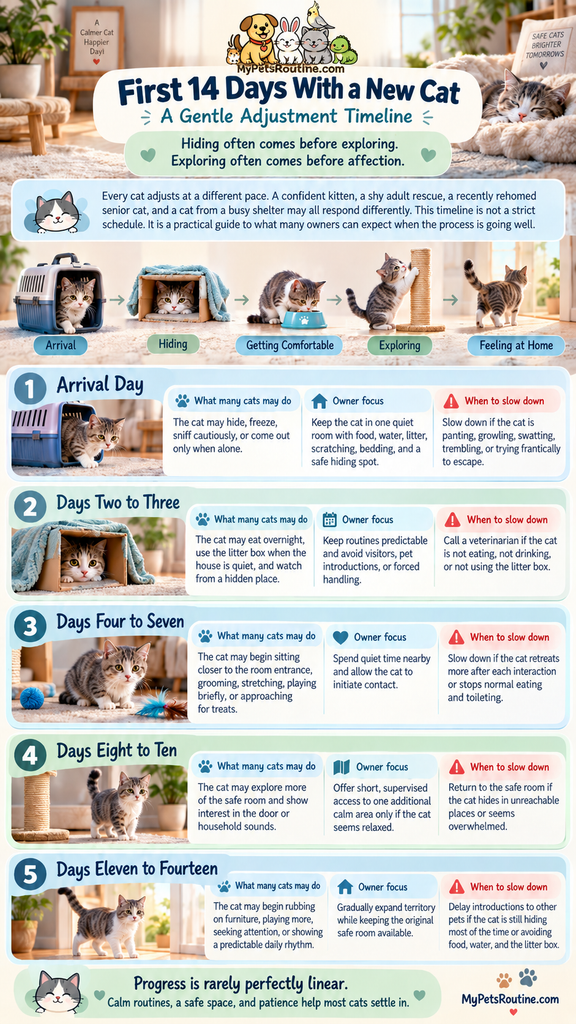
A Simple Confidence Curve for New Cat Adjustment
New owners often expect progress to move in a straight line, but cat adjustment usually looks uneven. A cat may seem brave on day four, hide again on day five after hearing the vacuum, then come out more confidently on day six. That does not mean the process failed. It means the cat is still learning which sounds, smells, and routines are safe.
It is also important to separate affection from adjustment. A cat can be making real progress even before they want to sit on your lap. Eating, drinking, toileting, grooming, scratching appropriate surfaces, and resting more openly are meaningful signs that the cat is becoming more comfortable and experiencing less stress in the home.
| Adjustment Stage | Common Confidence Level | What Progress May Look Like |
|---|---|---|
| First Arrival | Very Low | The cat hides, watches, and may only move around when the room is empty. |
| Basic Safety | Low to Moderate | The cat eats, drinks, and uses the litter box while still avoiding direct contact. |
| Curiosity | Moderate | The cat sniffs furniture, explores the room, plays briefly, and watches people more openly. |
| Choice-Based Interaction | Moderate to High | The cat approaches, accepts treats, slow blinks, rubs cheeks, or stays nearby. |
| Early Bonding | Growing | The cat seeks attention, rests in visible places, follows routine, and recovers faster from surprises. |
This table is useful because it separates affection from adjustment. A cat can be making real progress even before they want to sit on your lap. Eating, drinking, toileting, grooming, scratching appropriate surfaces, and resting more openly are meaningful signs of feline stress reduction.
How Routine Helps a Cat Feel Safe
Routine matters because it reduces the number of decisions a nervous cat has to make. When breakfast comes at roughly the same time, lights dim around the same part of the evening, play happens in short predictable sessions, and the litter box remains in one reliable location, the cat begins to trust the pattern of the home.
A good new cat routine does not need to be complicated. In the morning, refresh water, offer food, scoop the litter box, and spend a few calm minutes in the room. During the day, keep noise low near the safe room and avoid unnecessary rearranging. In the evening, offer a short wand toy session if the cat is interested, followed by food or a small treat. This sequence can feel natural to a cat because play followed by eating resembles a simplified version of hunting and feeding.
The important part is consistency. Cats often cope better when their environment feels familiar, and the AAFP and ISFM guidelines note that predictability, familiarity, and routine enhance feline coping ability.
Introducing People, Pets, and the Rest of the Home
A cat who is still hiding most of the day is usually not ready to meet the whole household. Introductions should happen after the cat has shown basic comfort in the safe room. That means eating reliably, using the litter box, resting, grooming, and showing curiosity.
Family introductions should be calm and brief. One person at a time is much easier than a group. Children should be taught to sit quietly and let the cat approach. Guests should wait. Even friendly attention can be overwhelming when a cat is still forming their first impression of the home.
Other pets require even more patience. Dogs should not be allowed to rush the safe room door, bark at the cat, or stare through a gate. Resident cats should not be pushed into face to face meetings before scent swapping and gradual exposure have taken place. Cats Protection recommends gradual introductions to family members and other pets, and specifically warns against forcing the cat to approach a dog.
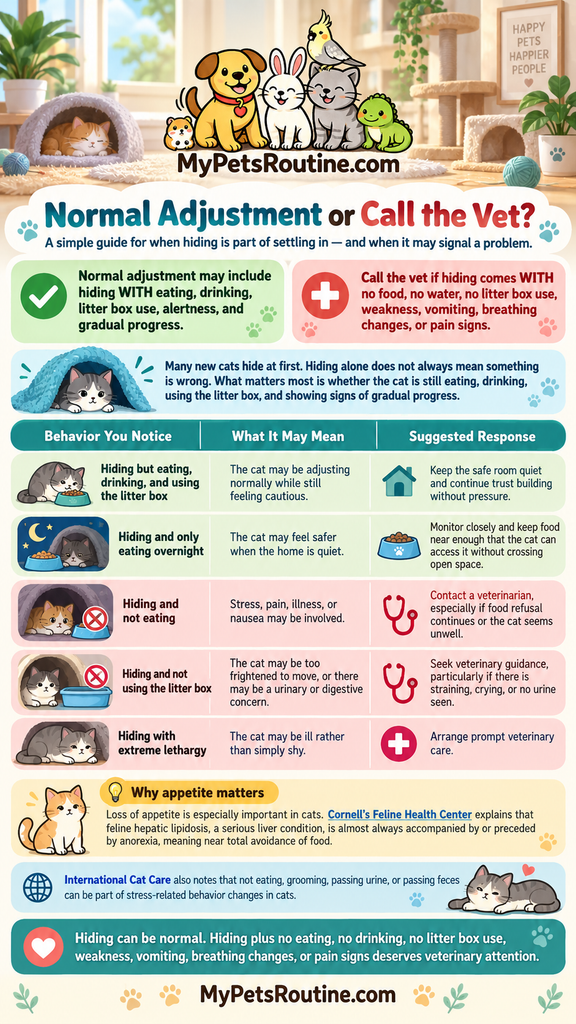
Warning Signs That Hiding May Be More Than Adjustment
Most new cat hiding improves gradually. However, hiding should never be used to dismiss possible illness, pain, dehydration, urinary problems, or severe stress. The most important distinction is whether your cat is hiding but still functioning, or hiding while basic needs are shutting down.
A cat who hides but eats overnight, drinks water, urinates, defecates, and seems alert may simply need time. A cat who hides and does not eat, does not drink, does not use the litter box, seems extremely weak, breathes abnormally, vomits repeatedly, cries in pain, strains in the litter box, or appears profoundly lethargic needs veterinary advice quickly.
The Quiet Way Cats Begin to Trust You
The first bond with a new cat often looks underwhelming from the outside. It may be a blink. A paw stretching out from under the bed. A meal eaten while you sit nearby. A tail held a little higher. A cheek rub against the corner of a cardboard box. These small moments matter.
Cats build trust through repeated experiences of safety. Each time your cat chooses to come closer and nothing frightening happens, the relationship grows. Each time your cat walks away and you respect it, the relationship grows. Each time the room smells familiar, the food arrives on schedule, the litter box stays clean, and people remain calm, the home becomes less strange.
Eventually, the hiding place becomes less of a bunker and more of a bedroom. Your cat may still use it after a loud noise, a visitor, or a stressful moment, and that is healthy. A confident cat does not stop needing safe places. A confident cat simply knows they can come out again.
Final Thoughts: Hiding Is Often the Beginning, Not a Bad Sign
A new cat hiding is not a failed introduction. In many cases, it is the first stage of adjustment. Your cat is not trying to be difficult, ungrateful, or distant. They are using a deeply natural survival strategy while they learn the smells, sounds, people, routines, and boundaries of a new territory.
The best thing a new owner can offer is not constant attention. It is safety, patience, predictability, and choice. Give your cat a quiet room. Let them hide. Sit nearby without forcing contact. Use slow blinks, soft speech, familiar routines, and gentle treat based interactions. Watch for small signs of progress, and take warning signs seriously when eating, drinking, litter box use, or energy level changes.
When you give a cat time to feel safe, you are not delaying the bond. You are building it correctly.