
 By
Kelley Kelly
By
Kelley Kelly
Cockatiels have a way of making first-time bird owners feel chosen. One day they are quietly watching from a perch, crest slightly raised, and the next they are whistling from across the room as if they have always belonged in the family. That charm is part of what makes cockatiels such beloved companion birds, but it can also make new owners underestimate how much daily structure these small parrots need.
A cockatiel is not a decoration for a pretty cage, and it is not a pet that thrives on food and fresh water alone. Cockatiels are intelligent, social, sensitive birds that need a safe cage location, varied perches, appropriate food, clean water, enrichment, supervised out-of-cage time, and dependable sleep. Bird welfare guidance emphasizes that pet birds need enough space for movement and flight, regular mental stimulation, safe social contact, good ventilation, and protection from fumes, drafts, and household hazards.
This beginner’s guide is designed to help new cockatiel owners build a simple, repeatable care routine. The goal is not perfection. The goal is a bird who feels secure enough to eat well, sleep well, explore, vocalize, preen, and interact without constant stress.
Why Cockatiel Care Works Best as a Daily Routine
A good cockatiel routine does two important things at once. It keeps the cage clean and the bird’s body healthy, but it also teaches the cockatiel that life is predictable. Predictability matters because cockatiels are prey animals. Sudden movements, loud noises, rough handling, inconsistent feeding, and chaotic room activity can make a new bird feel exposed even when the owner has loving intentions.
Routine helps a cockatiel learn when fresh food appears, when the cage is cleaned, when the room becomes quiet for sleep, and when interaction is safe. Over time, that rhythm builds trust. A bird who knows what to expect is more likely to step up willingly, play with toys, eat a broader diet, and vocalize normally instead of screaming from confusion or boredom.
For a first-time owner, the easiest way to think about cockatiel care is to divide the day into connected care moments. Morning is for clean water, fresh food, cage paper, and a calm greeting. Daytime is for light, enrichment, safe household presence, and supervised time outside the cage. Evening is for another water check, removal of spoiled fresh food, gentle interaction, and a gradual transition into sleep.
Choosing the Best Cage Location for a Cockatiel
Light, Calm Activity, and Social Placement
The best cage location lets your cockatiel feel included without being overwhelmed. Cockatiels are social birds, so a cage hidden in a spare room can leave them lonely and under-stimulated. At the same time, placing the cage in the busiest, loudest spot in the home can create constant stress. A good location is usually a living area where the bird can see family activity, hear normal household sounds, and enjoy regular interaction while still having a quiet retreat.
A cockatiel cage should be in a well-lit area, but not where direct sun bakes the cage for long periods. PetMD notes that cockatiels are comfortable in typical household temperatures between 65 and 80 degrees Fahrenheit and should be kept in a well-lit, draft-free habitat away from air conditioners and other pets. Natural daylight helps a bird’s daily rhythm, but glass windows do not provide meaningful ultraviolet exposure because window glass filters UV light. PetMD recommends bird-safe full-spectrum UV lighting or carefully supervised outdoor exposure in a secure outdoor cage when weather permits.
A cage against one wall often feels safer than a cage floating in the middle of a room. The wall gives the bird a protected side, which can reduce the feeling of being watched from every direction. Height also matters. A cage should not sit directly on the floor where the bird feels vulnerable to feet, vacuums, dogs, cats, and sudden movement. A stable cage stand or sturdy table is better, as long as the cage cannot wobble or tip.
Drafts, Kitchen Hazards, and Air Quality
The kitchen is one of the worst places for a cockatiel cage. Birds have delicate respiratory systems, and they are far more vulnerable than humans to airborne toxins. RSPCA housing guidance warns that indoor birds need ventilation but must also be protected from drafts and fumes, including cleaning products, paint products, cigarette smoke, cooking gas, air fresheners, scented candles, incense, and self-cleaning ovens.
Nonstick cookware deserves special attention. VCA Canada explains that polytetrafluoroethylene, commonly known as PTFE, can poison birds when fumes are released from overheated nonstick products. Signs may include agitation, rapid or labored breathing, wheezing, weakness, incoordination, seizures, coma, and sudden death. VCA Canada advises that the only reliable way to prevent PTFE poisoning is to eliminate PTFE-containing nonstick products from the home, or at minimum keep birds away from areas where those products are used and avoid overheating them.
This is why “not in the kitchen” should be treated as a basic cockatiel care rule rather than a preference. Even if the bird seems calm near cooking activity, fumes can become dangerous before an owner realizes there is a problem.
| Cage Location Factor | Better Choice for a Cockatiel | Why It Matters |
|---|---|---|
| Light | Bright room with indirect daylight and a stable day rhythm | Supports natural wake and rest patterns without overheating the cage |
| Airflow | Ventilated room without drafts | Fresh air matters, but cold drafts and direct vents can stress the bird |
| Social contact | Family room or quiet living area | Allows interaction without constant commotion |
| Kitchen exposure | Cage kept far from cooking areas | Reduces risk from smoke, PTFE fumes, cooking gas, and aerosolized oils |
| Other pets | Cage placed where dogs and cats cannot reach or stalk | Prevents fear, injury, and chronic stress |
| Sleep | Quiet evening location or sleep cage | Helps the bird settle without television, lights, or late-night activity |
Cockatiel Cage Setup: Size, Layout, and Comfort
A cockatiel’s cage should allow more than sitting and turning around. It should give the bird room to stretch, flap, climb, move between perches, eat without contamination from droppings, and play without crowding. RSPCA Knowledgebase notes that birds need both horizontal and vertical space for natural movement and flight, and that narrow cages with height but little width often do not provide suitable dimensions because birds do not fly straight up and down like helicopters.
For a single cockatiel, many care references recommend a cage that is wider than it is tall, with safe bar spacing that prevents the bird’s head from getting trapped. Wider cages let a cockatiel make short flights or strong hops from perch to perch. A tall but narrow cage may look impressive in a room, yet it often offers less useful movement space.
The cage floor should be easy to monitor. Paper-based liners are useful because droppings are visible, which helps you notice changes in stool, appetite, or hydration. PetMD recommends daily spot-cleaning, removal of soiled material and discarded food, daily washing of food and water bowls, and weekly replacement of substrate or bedding liners, with more frequent cleaning when more than one bird shares the habitat.
A clean cage is not only about odor. It is one of the easiest health checks a bird owner has. Changes in droppings, reduced mess around the food dish, untouched vegetables, or unusual feather debris on the cage floor can tell you something is off before your cockatiel looks obviously sick.
Perches: Why Diameter, Texture, and Placement Matter
Healthy Feet Need Variety
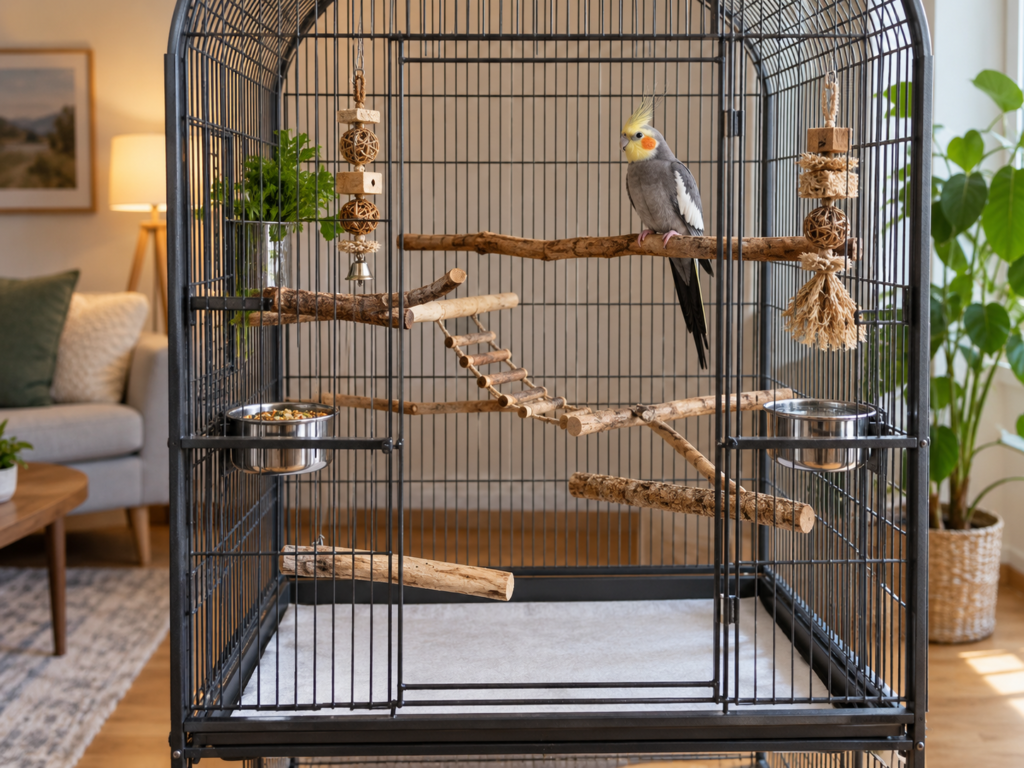
Perches are not just places to sit. They shape your cockatiel’s foot health, balance, confidence, and daily activity. In the wild, birds stand on branches of different widths and textures, so their feet naturally shift position throughout the day. In a cage with identical smooth dowel perches, the same parts of the foot bear pressure again and again. VCA explains that perches of varied sizes give birds more exercise opportunities and reduce the repeated pressure that can contribute to foot sores and bumblefoot.
A good cockatiel cage usually includes natural wood perches of different diameters, a comfortable rope perch if it is closely monitored, and possibly one textured perch placed thoughtfully rather than used as the main resting surface. VCA notes that a bird’s toes should wrap about three-quarters of the way around the perch; if the perch is too large, the bird cannot grip properly and may slip or fall.
Natural branches can be excellent, but they must come from bird-safe, non-toxic trees and should be cleaned and disinfected before use. VCA identifies washed and disinfected branches such as apple, elm, ash, maple, and willow as options that can provide both function and enrichment. Sandpaper perch covers are not a good shortcut for nail care. VCA warns that sandpaper covers can irritate and sore the bottoms of birds’ feet, and PetMD similarly states that sandpaper perches and sanded covers can be abrasive and are not recommended.
Perch Placement Makes the Cage Easier to Live In
Perches should be arranged so your cockatiel can move naturally through the cage without banging tail feathers on bars or soiling food and water dishes. PetMD advises not placing perches above food or water bowls because droppings can fall into them. A higher sleeping perch in a quiet corner can help the bird feel secure at night, while mid-level perches near food and toys encourage normal movement during the day.
The cage should not become so crowded with accessories that the bird cannot open its wings. A common beginner mistake is to buy many toys at once and fill every empty space. Cockatiels need enrichment, but they also need open space. The better setup is simple, balanced, and changeable.
| Perch Type | Best Use in a Cockatiel Cage | Watch Carefully For |
|---|---|---|
| Natural wood branch | Main daily standing and climbing surface | Splinters, unsafe wood species, droppings buildup |
| Varied diameter wood perch | Foot exercise and pressure relief | Perches that are too wide or too smooth |
| Natural cotton or hemp rope perch | Softer grip and comfort | Fraying strands that can trap toes or be swallowed |
| Textured cement or mineral perch | Occasional nail and beak wear near a food area | Overuse that irritates foot pads |
| Flat platform perch | Resting option for older, weak, or disabled birds | Soiling and reduced movement if it becomes the only favorite spot |
Toys and Enrichment: Preventing Boredom Before It Becomes a Problem
Cockatiels are small parrots, and parrots are intelligent. A bored cockatiel may scream for attention, chew unsafe household items when out of the cage, become fearful, or over-preen. PetMD notes that cockatiels should have enrichment toys to reduce boredom and encourage mental and physical stimulation, and that lack of stimulation can contribute to harmful habits such as feather plucking.
Good toys give a cockatiel something to shred, chew, climb, investigate, or forage from. RSPCA recommends safe, non-toxic enrichment materials such as untreated wood, paper, cardboard, pine cones, natural fiber rope, cardboard boxes, safe twigs, ladders, ropes, and nets in suitable large spaces. For a cockatiel, simple toys are often better than complicated ones. Soft wood, palm leaf, seagrass, crinkle paper, cardboard, and small foraging cups can keep a bird busy without overwhelming it.
Toy rotation is useful because novelty keeps the bird interested. That does not mean every toy should be replaced daily. Too much change can make a cautious cockatiel nervous. A better rhythm is to keep a few familiar favorites in place while rotating one item every few days or each week. When adding a new toy, place it near the outside of the cage first if your bird is timid. Let curiosity build.
Safety matters as much as stimulation. Toys should not have tiny parts that can be swallowed, sharp edges, loose metal pieces, unsafe bells, long fraying fibers, or clips that the bird can open and catch a beak or foot on. PetMD warns that hanging toys should be securely attached and should not contain small removable parts that can be swallowed.
Cockatiel Food: Building a Balanced Daily Diet
Pellets, Vegetables, Seeds, and Treats
Many new cockatiel owners picture a bowl of seed as the classic bird diet. Cockatiels do enjoy seeds, but an all-seed diet is not balanced. VCA recommends a pelleted food formulated for birds as the foundation of a cockatiel’s diet and states that pellets should ideally make up approximately 75 to 80 percent of the diet.
That does not mean a cockatiel should never receive seeds. Seeds can be useful as training rewards, foraging items, or small treats, especially when transitioning a bird toward healthier eating. The problem is relying on seed as the main diet. Seed-heavy diets tend to be too selective, too fatty, and too limited in key nutrients.
Fresh vegetables add variety and enrichment. Leafy greens, grated carrot, cooked sweet potato, broccoli, peas, bell pepper, and other bird-safe produce can make meals more interesting. Fruit should be limited because it is higher in sugar and water. VCA advises washing fruits and vegetables thoroughly, cutting them into appropriately sized pieces, removing apple seeds because they may be toxic to birds, and leaving fresh produce in the cage for no more than a couple of hours because it can spoil.
Diet changes should be gradual. A cockatiel who has eaten mostly seed may not recognize pellets or vegetables as food at first. VCA notes that conversion to pellets can take days, weeks, or months, and recommends consulting a veterinarian familiar with birds if problems arise during diet transition.
| Daily Diet Component | Role in Cockatiel Care | Practical Feeding Note |
|---|---|---|
| Pelleted cockatiel food | Main nutritional foundation | Offer consistently and choose a quality bird formula |
| Fresh vegetables | Variety, moisture, nutrients, and enrichment | Remove uneaten fresh food after a short period to prevent spoilage |
| Seeds | Treats, training rewards, and foraging motivation | Avoid letting seed become the main diet |
| Fruit | Occasional variety | Use sparingly because of natural sugar |
| Clean water | Hydration and normal digestion | Wash the bowl every day and refresh water whenever it is dirty |
Water and Cage Hygiene: Small Tasks That Prevent Big Problems
Fresh water should always be available. Cockatiels may drop hulls, pellets, toy fibers, or droppings into a water dish, so checking water once a day is not always enough. VCA states that fresh, clean water must be available at all times and that dishes should be cleaned thoroughly every day with soap and water.
A morning water change and an evening water check create a simple safety net. If the bird bathes in the dish, tosses food into it, or contaminates it during the day, the evening check catches the problem before bedtime.
Cage paper should also be changed or checked daily. This keeps the environment cleaner and gives you a clear view of droppings. A cockatiel’s droppings can vary depending on diet, but sudden changes, very watery output, unusual color, lack of droppings, or a major decrease in volume can be early warning signs. Birds often hide illness, so daily observation is one of the most valuable habits a new owner can develop.
When cleaning, avoid strong fumes. PetMD cautions that birds’ respiratory systems are sensitive to aerosolized fumes and recommends using cleaning agents formulated for pet habitats when cleaning a cockatiel’s cage. The bird should be moved to a safe space away from cleaning fumes, sprays, and disinfectants.
Daily Interaction: How Much Attention Does a Cockatiel Need?
Cockatiels are flock animals. Even when housed alone, they still have social needs. RSPCA notes that many pet birds consider their human family part of their social flock and benefit from appropriate integration into daily family activity. For a cockatiel, this does not always mean constant handling. Some birds love stepping onto a hand. Others prefer sitting near their person, whistling, accepting treats, or watching household activity from a play stand.
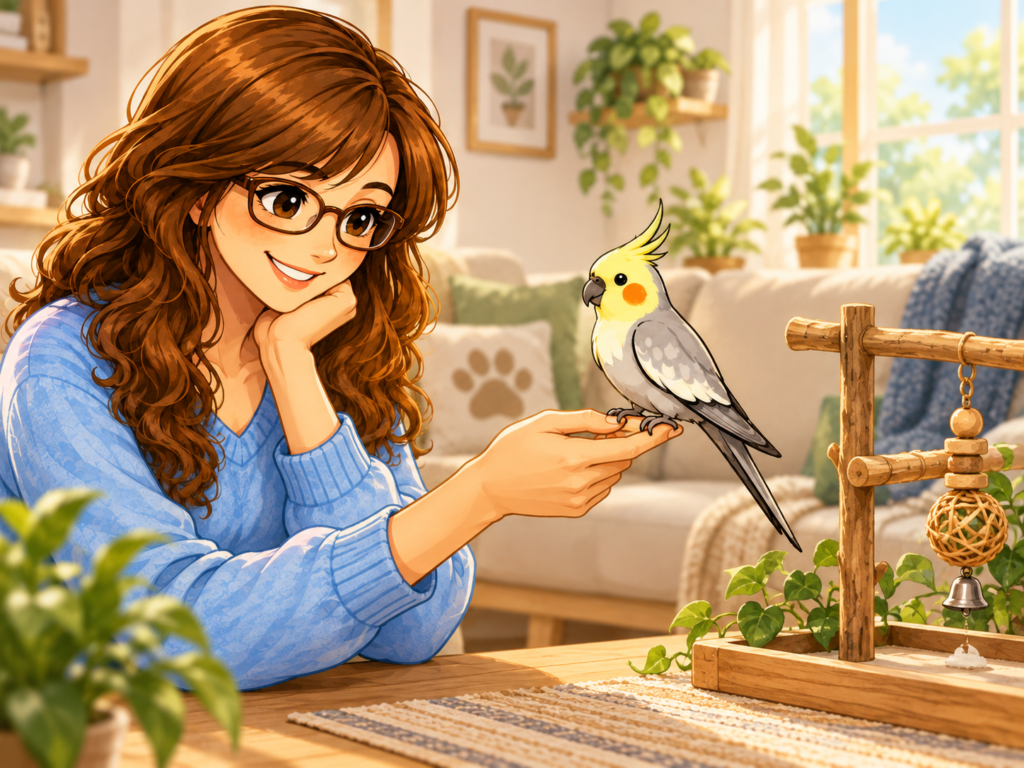
Daily interaction should be calm and predictable. A new cockatiel may need several days or weeks to settle before it is ready for confident handling. During that period, sitting near the cage, speaking softly, offering a small treat through the bars, and moving slowly can do more for trust than trying to grab the bird. Cockatiels usually respond poorly to being chased around the cage. A hand that invades the cage too quickly can feel like a predator, especially if it comes from above.
Step-up training should be short and positive. The bird learns that a hand is not a trap, that stepping up leads to praise or a favorite treat, and that interaction ends before fear builds. Several gentle sessions of a few minutes are often better than one long session that leaves the bird tired or defensive.
A healthy daily interaction rhythm includes quiet companionship, vocal engagement, training, and supervised exploration. Cockatiels often enjoy whistling games, gentle head scratches when they solicit them, and simple foraging activities. The key is consent. A bird who leans away, hisses, lunges, pins feathers tight, or tries to flee is communicating discomfort. Respecting that signal builds trust faster than forcing contact.
Out-of-Cage Time: Exercise, Supervision, and Bird-Safe Rooms
Out-of-cage time is one of the most important parts of cockatiel care, but it must be supervised. RSPCA states that birds permanently confined to cages must have regular access to flight opportunities in a safe environment, such as indoors. Flight and climbing help prevent boredom, support muscle tone, and give the bird a healthier outlet for energy.
A bird-safe room should be prepared before the cage door opens. Windows and mirrors should be made visible with curtains, blinds, decals, or temporary coverings so the bird does not fly into them. Ceiling fans should be off. Open toilets, hot drinks, candles, fireplaces, uncovered aquariums, electrical cords, toxic plants, and small chewable objects should be removed or blocked. Dogs, cats, and other pets should be in another secure area, even if they seem gentle. A predator does not need to intend harm for a cockatiel to be terrified or injured.
Kitchen access should be avoided during out-of-cage time. Cooking, hot pans, boiling water, open flames, knives, slippery counters, and airborne fumes make kitchens unsafe for birds. Laundry rooms can also be risky because of fumes, machines, and small hiding spaces.
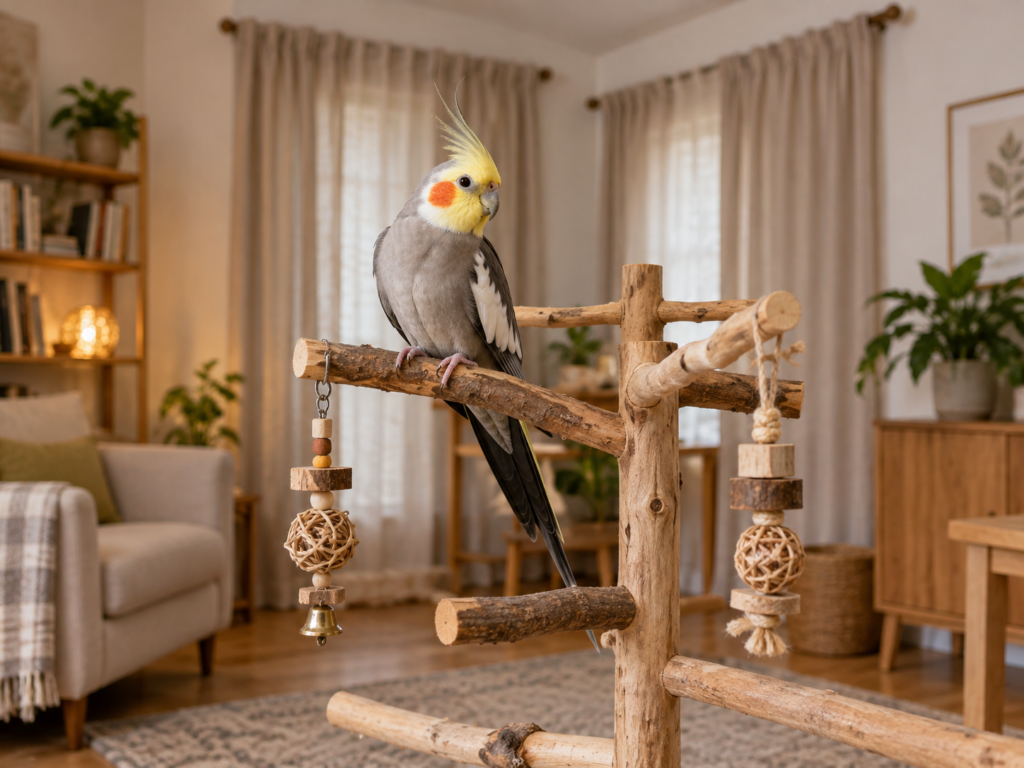
A play stand near the family area can make supervised freedom easier. It gives the bird a defined place to land, chew, forage, and interact. Returning to the cage should feel normal rather than like punishment. Offering a favorite food inside the cage after playtime can help your cockatiel learn that going home is part of the routine.
| Out-of-Cage Hazard | Why It Matters | Safer Setup |
|---|---|---|
| Windows and mirrors | Cockatiels may not recognize clear or reflective barriers | Cover or mark surfaces before flight time |
| Ceiling fans | Moving blades can cause severe injury | Turn fans off before the cage opens |
| Dogs and cats | Predatory behavior, stalking, or sudden play can injure or terrify birds | Keep other pets out of the room |
| Kitchen activity | Heat, fumes, sharp tools, and open liquids create multiple risks | Keep birds out of kitchens completely |
| Open water | Toilets, sinks, buckets, and aquariums can become drowning hazards | Close lids and cover or remove water sources |
| Electrical cords | Cockatiels chew and explore with their beaks | Block access and supervise closely |
Sleep: The Overlooked Part of Cockatiel Care
Sleep can affect a cockatiel’s mood, immune function, vocal behavior, and ability to cope with daily activity. Many cockatiels do best with a quiet, darkened, predictable sleep period. A cockatiel care guide from HARI recommends 10 to 12 hours of uninterrupted sleep and notes that cockatiels can be prone to night fright, so a quiet covered sleeping area and a small night light may help some birds feel secure.
The phrase “covered cage” can confuse new owners. A cover is not mandatory for every bird, and some cockatiels panic if they are suddenly covered after never experiencing it. The purpose is not to trap the bird in darkness. The purpose is to reduce visual stimulation, drafts, and household disruption. If your cockatiel sleeps well uncovered in a quiet room, a full cover may not be necessary. If the room stays active late into the evening, a cover or separate sleep cage in a calmer location may help.
Night frights are especially important with cockatiels. A sudden noise, flash of headlights, moving shadow, or vibration can cause a cockatiel to thrash in the cage at night. This can break blood feathers, damage wings, or cause bruising. A dim night light can help some birds reorient themselves if startled. The sleep cage should be arranged so the bird has secure perches and enough space to regain balance without crashing into crowded toys.
The Cockatiel Daily Care Wheel
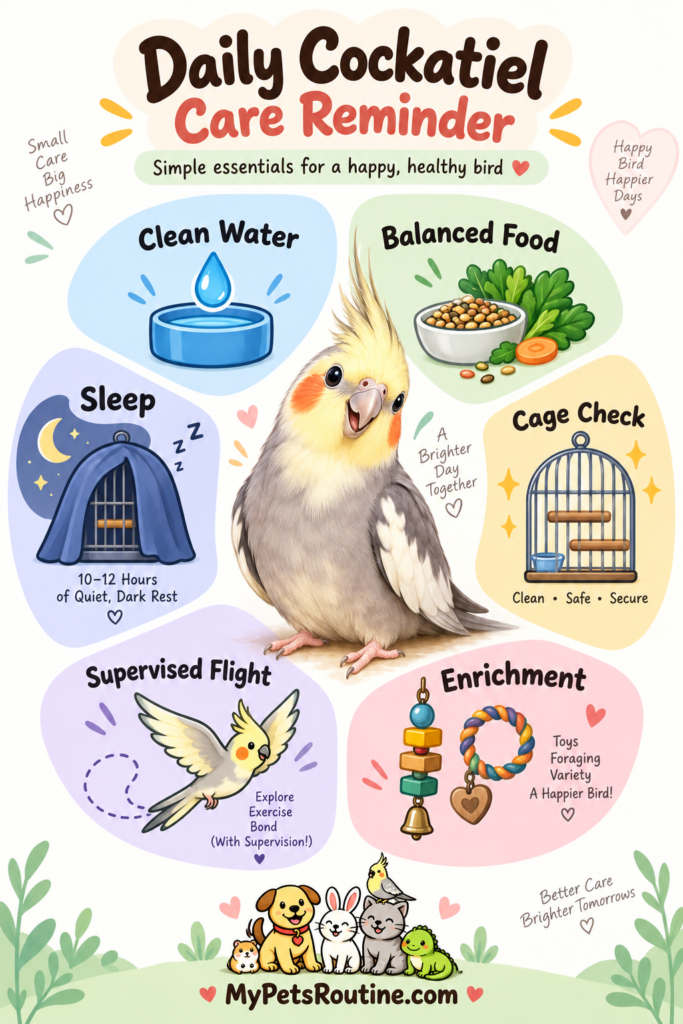
| Time of Day | Care Focus | What the Owner Is Watching For |
|---|---|---|
| Morning | Fresh water, pellet check, clean cage paper, calm greeting | Appetite, droppings, posture, energy, normal vocalization |
| Late morning | Fresh vegetables or foraging activity | Curiosity, willingness to explore food, toy engagement |
| Afternoon | Social presence, supervised out-of-cage time, training | Balance, confidence, safe flight, relaxed body language |
| Evening | Remove spoiled fresh food, refresh water if needed, quiet interaction | Full crop, normal behavior, no signs of stress or injury |
| Night | Darkened quiet sleep period with safe perch setup | Restful sleep, reduced disturbance, prevention of night fright |
Common Beginner Mistakes That Make Cockatiel Care Harder
Many cockatiel problems begin with good intentions and incomplete information. A new owner may place the cage in the kitchen because the family spends time there, not realizing that cooking fumes are dangerous. Another may buy a tall decorative cage because it looks spacious, even though the bird has little horizontal room to move. Someone else may fill the cage with toys but forget that the bird still needs open wing space and a stable sleep perch.
Diet mistakes are also common. A cockatiel who eats only seed may seem happy because it chooses the tastiest items first, but preference is not the same as balanced nutrition. VCA’s recommendation that pellets form the majority of the diet is meant to prevent the long-term nutritional problems that can come from selective feeding.
Another common mistake is expecting affection too quickly. Cockatiels can become deeply bonded to people, but trust develops through repeated safe experiences. A bird who hisses on the first day is not mean. It is scared. A bird who refuses vegetables is not stubborn. It may not yet recognize them as food. A bird who screams when left alone may be calling for its flock, reacting to boredom, or struggling with an inconsistent routine.
Good care becomes easier when owners stop asking, “How do I make my cockatiel behave?” and start asking, “What does my cockatiel need to feel safe, healthy, and included?”
When to Call an Avian Veterinarian
First-time owners should establish care with an avian veterinarian early, not only when something goes wrong. Birds hide illness well, and by the time a cockatiel is sitting fluffed, weak, not eating, breathing heavily, or staying at the bottom of the cage, the situation may already be urgent.
Call an avian veterinarian promptly if your cockatiel stops eating, has labored breathing, sits fluffed for long periods, cannot perch, has discharge from the eyes or nostrils, shows blood, has repeated vomiting or regurgitation outside normal courtship behavior, produces abnormal droppings, becomes suddenly quiet, or suffers a crash or injury during night fright. If there is any possible exposure to PTFE fumes or household toxins, move the bird to fresh air immediately and contact a veterinarian or poison control service. VCA Canada identifies PTFE exposure as a serious emergency and advises immediate fresh air and veterinary or Pet Poison Helpline guidance if exposure is suspected.
Final Thoughts: A Healthy Cockatiel Starts With a Predictable Home
Cockatiel care is not complicated because the bird is difficult. It is complicated because birds are sensitive, intelligent, and easy to misunderstand. A cockatiel needs more than a cage in the corner and a bowl of seed. It needs a thoughtfully placed cage, clean air, varied perches, safe toys, balanced nutrition, fresh water, supervised exercise, daily social contact, and a quiet sleep rhythm.
Once those basics are in place, the relationship becomes far more rewarding. Your cockatiel begins to recognize your voice, anticipate parts of the day, explore new toys, taste new foods, and participate in family life in its own bright, curious way. The care routine becomes less like a checklist and more like a conversation. Every morning water change, every clean sheet of cage paper, every patient step-up session, and every quiet evening routine tells your bird the same thing: you are safe here.