
 By
Kelley Kelly
By
Kelley Kelly
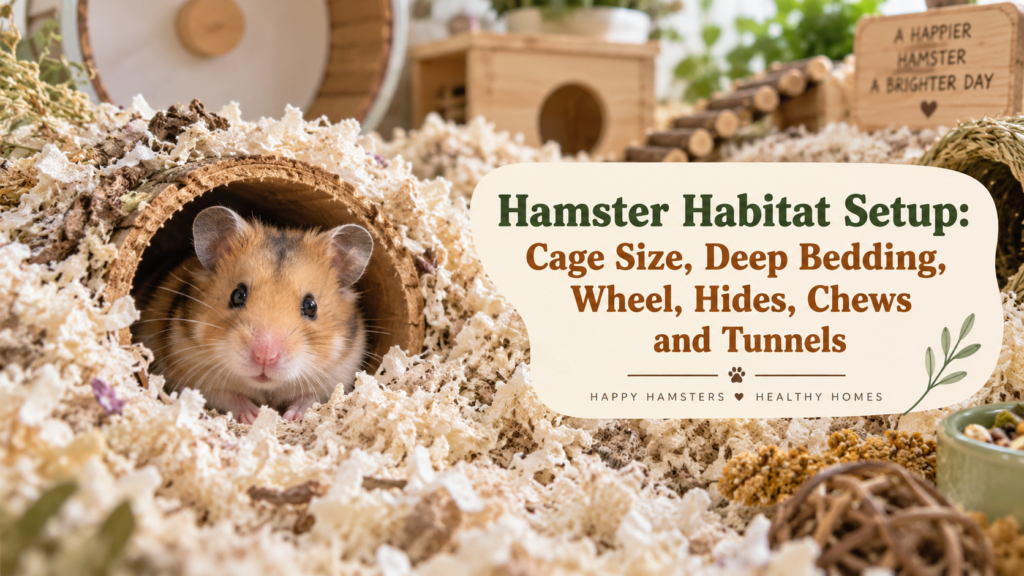
Bringing home a hamster often feels simple at first. They are tiny, quiet, inexpensive compared with many larger pets, and easy to fall in love with at the pet store. That small size, however, is exactly what causes many new owners to underestimate what a hamster really needs. A hamster may fit in the palm of your hand, but in the wild, hamsters travel, dig, forage, hide, nest, and patrol surprisingly large areas. A good hamster habitat is not just a container that keeps your pet from escaping. It is the foundation of your hamster’s physical health, emotional security, and daily quality of life.
For new hamster owners, the biggest beginner mistake is choosing a cage that is too small and too shallow. Many brightly colored starter cages look cheerful on the shelf, but they often provide very little uninterrupted floor space, limited bedding depth, tiny wheels, and cramped plastic tunnels that do more for human decoration than hamster welfare. A well-planned hamster enclosure should give your pet room to move naturally, bedding deep enough for burrowing, a safe exercise wheel, secure hiding places, chew materials, and enrichment that encourages exploration without overwhelming them.
Blue Cross recommends a hamster home no smaller than 100 cm by 50 cm of floor space and 50 cm tall, noting that bigger is better because hamsters love to explore and roam. Blue Cross also explains that tanks or aquariums can work well because they allow for deep bedding and reduce escape risk, provided they have a secure mesh lid for ventilation. Merck Veterinary Manual also emphasizes that regular exercise is necessary for hamsters and that exercise wheels should have solid running surfaces to help protect their feet and bones. These details matter because a hamster habitat is not decoration. It is your pet’s entire world.
Why Hamsters Need More Space Than People Expect
A hamster’s body is small, but its instincts are not. Even a calm pet hamster still carries the natural drive to dig, run, tunnel, stash food, groom, sleep in a hidden nest, and investigate its surroundings after dark. When a hamster is kept in a tiny cage with shallow bedding and little enrichment, those instincts have nowhere healthy to go. Some hamsters begin chewing bars, pacing, climbing obsessively, freezing, hiding constantly, or becoming difficult to handle. Owners may assume the hamster is unfriendly or hyperactive, when the real problem may be that the habitat does not support normal hamster behavior.
Good hamster care begins by thinking horizontally rather than vertically. Hamsters are not climbing animals in the same way rats or mice are. They may climb when given bars or platforms, but they are not especially graceful at descending, and falls can be dangerous. What they need most is continuous floor space. A long, low enclosure gives a hamster room to run across the ground, arrange nest areas, create food storage spots, use a sand bath, visit a wheel, and explore tunnels without everything being stacked on top of itself.
A spacious enclosure also makes the habitat easier to organize. When the cage is too small, the wheel, food dish, water bottle, hides, bedding, chew toys, and toilet corner all compete for the same few inches. In a larger setup, the habitat can be arranged in zones. One side can hold deeper bedding for burrowing. Another can hold the wheel on a stable platform. A quiet corner can become the nesting area. A separate area can offer sand for grooming. This kind of thoughtful hamster cage setup helps the animal feel safer because the environment becomes predictable and functional.
Choosing the Right Hamster Cage Size and Type
The best hamster cage is one that provides generous uninterrupted floor space, allows deep bedding, prevents escape, gives proper ventilation, and can be cleaned without destroying the hamster’s entire sense of home. The Blue Cross guideline of at least 100 cm by 50 cm by 50 cm is a helpful starting point for owners who want to avoid undersized housing. Larger is even better when the layout is safe and practical.
Glass tanks, large aquariums, custom wooden enclosures with sealed surfaces, and large bin cages can all work when they are designed properly. Glass tanks and aquariums are popular because they hold deep bedding well, reduce bedding scatter, and make escapes less likely. Their main requirement is a secure mesh lid that allows airflow while preventing the hamster from climbing out. Wire cages can provide excellent ventilation, but they must have a deep base for bedding, safe bar spacing, and no wire mesh flooring. RSPCA guidance warns that wire mesh floors can lead to foot problems and recommends solid cage floors with bedding deep enough to allow digging and, where possible, burrowing.
Plastic modular cages often appeal to children because they are colorful and come with tubes, pods, and compartments. Unfortunately, many are too small, poorly ventilated, difficult to clean, and easy for determined hamsters to chew. Some plastic tubes are also too narrow for Syrian hamsters, especially when they have full cheek pouches. A tunnel that looks cute from the outside can become stressful or unsafe if a hamster cannot turn around comfortably, clean itself, or move through without squeezing.
Escape prevention is another essential part of hamster housing. Hamsters are skilled at finding weaknesses. A loose lid, wide bar spacing, flexible plastic edge, or poorly fitted door can become an escape route. This is not just inconvenient. An escaped hamster may chew electrical cords, hide inside walls, fall from furniture, encounter other pets, or become injured before anyone realizes what happened. A secure hamster enclosure should be checked from the hamster’s point of view. Any gap that looks small to a person may still be large enough for a determined dwarf hamster to test.
Hamster Cage Type Comparison
| Cage Type | Strengths | Concerns | Best Use |
|---|---|---|---|
| Glass tank or aquarium with mesh lid | Holds deep bedding, reduces mess, limits chewing and escape risk | Heavy, requires a secure ventilated lid, can be harder to move | Excellent for deep bedding and burrowing setups |
| Large wire cage with deep base | Good airflow, easy access, widely available | Bedding may scatter, bar chewing may occur, bar spacing must be safe | Suitable when the base is deep and floor space is generous |
| Large bin cage with mesh ventilation | Affordable, lightweight, customizable, holds bedding well | Must be carefully modified for airflow and security | Good budget option when built safely |
| Plastic modular cage | Visually appealing, often marketed for beginners | Often too small, limited ventilation, difficult to clean, chew risk | Usually best avoided unless exceptionally spacious and safe |
| Custom wooden enclosure | Spacious, attractive, flexible layout | Must be sealed safely, may be expensive, ventilation must be planned | Strong option for experienced owners who want a large permanent habitat |
Deep Bedding Is Not Optional for a Natural Hamster Habitat
Deep bedding is one of the most important parts of a hamster habitat because it allows the hamster to do what hamsters are built to do. Burrowing is not a bonus activity. It is a core behavior. A hamster that can dig tunnels and build a hidden nest often appears calmer because it has control over its own sense of safety. When the bedding is too shallow, the hamster may still try to dig, but the behavior becomes frustrating because every tunnel collapses before it can become useful.
Deep bedding also supports nesting, temperature comfort, scent stability, and odor control. Hamsters use bedding to shape their environment. They move it, pack it, fluff it, tunnel through it, and arrange it around food stores. A thick layer of soft, unscented paper bedding is commonly used because it holds structure better than many loose materials and tends to be gentler on the respiratory system than dusty bedding. Some owners mix in soft hay to help support tunnel structure, but bedding should never be sharp, moldy, dusty, heavily scented, or treated with strong fragrances.
Odor control is another reason deep bedding works better than shallow bedding. A thin layer becomes dirty quickly and often forces owners into full cage cleanouts. Full cleanouts may seem hygienic from a human perspective, but for a hamster, they can be stressful because they remove familiar scent markers. A deep, well-managed enclosure usually allows spot cleaning. The soiled corner can be removed while much of the clean bedding remains in place. This keeps the habitat fresher without constantly erasing the hamster’s home.
The goal is to create bedding deep enough for real digging, not just a decorative layer on the floor. In many habitats, owners create one extra-deep burrowing zone while keeping the wheel and water area more stable. This can be done by sloping the bedding or using platforms that keep heavy items from sinking. The bedding should never be so shallow that the hamster is forced to sleep exposed unless it chooses to.
Bedding Depth and Habitat Function Chart
| Bedding Depth | What the Hamster Can Usually Do | Habitat Result |
|---|---|---|
| Thin surface layer | Scratch, shuffle, and make a shallow nest | Limited natural behavior and quicker odor buildup |
| Moderate bedding layer | Nest more comfortably and dig short shallow areas | Better comfort but limited tunnel stability |
| Deep bedding zone | Burrow, tunnel, hide, stash food, and build a secure nest | Stronger enrichment, more natural behavior, and better scent stability |
Wheel Safety: Why the Right Running Wheel Matters
A hamster wheel is one of the most important items in the enclosure, but not every wheel is safe. Hamsters need regular exercise, and a wheel gives them a way to run during their active hours. Merck Veterinary Manual notes that regular exercise is necessary for hamsters and specifically recommends choosing a wheel with a solid running surface to protect feet and bones. Merck also explains that broken bones can occur when a hamster’s leg becomes trapped in a wire exercise wheel or wire or mesh caging material, which is why solid-surface wheels and cage materials are recommended.
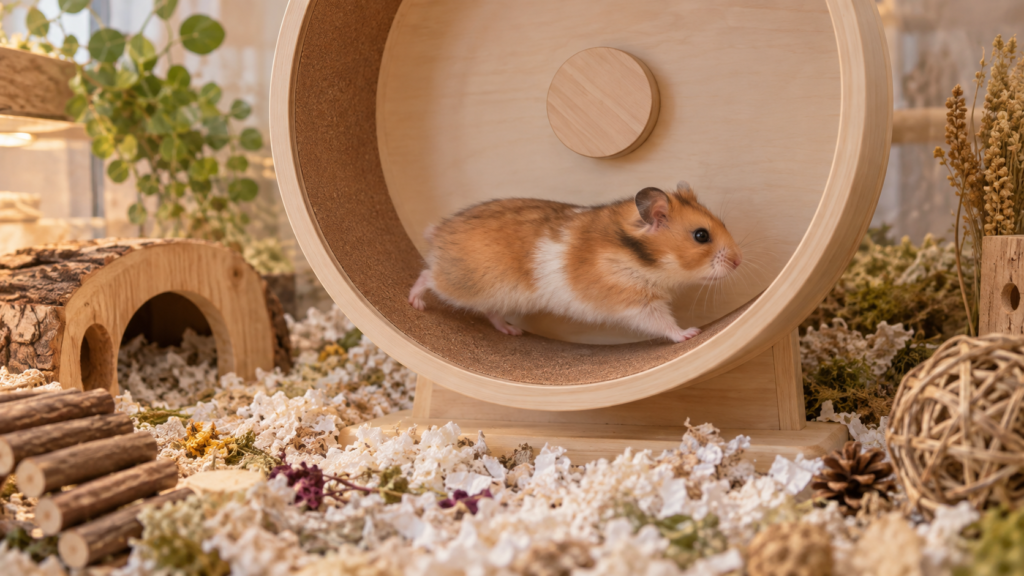
The wheel should be large enough for the hamster to run with a natural posture. If the wheel is too small, the hamster’s back may arch while running. Over time, this can create discomfort and may discourage healthy exercise. Syrian hamsters generally need larger wheels than dwarf hamsters, and even dwarf hamsters need a wheel that lets them run without being cramped. The wheel should spin smoothly, stand securely, and have no open rungs, sharp seams, or gaps where feet can catch.
A good wheel is also quiet enough that the owner will leave it in the habitat. Hamsters are crepuscular or nocturnal by nature, which means much of their activity happens in the evening, overnight, and early morning. A squeaky wheel can tempt people to remove it at night, but that removes a major outlet for natural movement exactly when the hamster is most active. Choosing a sturdy, quiet, solid wheel from the beginning helps both the hamster and the household.
Placement matters as much as the wheel itself. A heavy wheel should be placed on a stable platform or on a lower-bedding area so it does not tip or sink. It should not block the entrance to a hide, press against the wall, or sit so close to bedding that it cannot spin. The hamster should be able to enter and leave easily.
Hides and Tunnels Help Hamsters Feel Safe
Hamsters are prey animals, which means they are wired to value cover, darkness, and escape routes. A habitat with only open space may look clean and simple, but to a hamster it can feel exposed. Hides and tunnels give the hamster choices. They allow the animal to sleep out of view, move through the habitat with confidence, and retreat when startled by sound, light, movement, or handling.
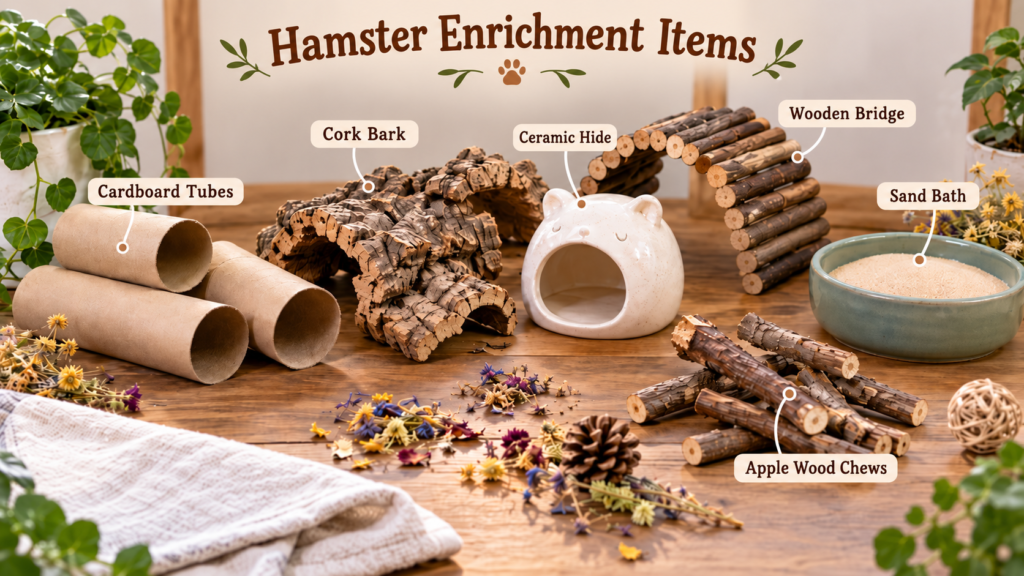
A good hamster hide should be large enough for the hamster to enter comfortably, turn around, groom, and sleep. It should have safe openings and no sharp edges. Multi-chamber hides can be especially useful because they mimic the feel of a burrow system, with separate areas for nesting and food storage. Ceramic hides, wooden houses, cardboard boxes, cork tunnels, and bendable wooden bridges can all add structure when they are hamster-safe and appropriately sized.
Tunnels can also be helpful, but they should be chosen carefully. A tunnel should be wide enough for the hamster’s body with full cheek pouches. This is especially important for Syrian hamsters, which can become stuck in narrow tubes. Cardboard tunnels are excellent because they are chewable, inexpensive, and easy to replace. Cork tunnels provide a natural texture and can be partly buried in bedding to create a more realistic exploration area. Long plastic tube systems are less ideal when they are cramped, poorly ventilated, hard to clean, or positioned in a way that makes the hamster sleep or hoard food in damp enclosed spaces.
Security reduces stress. A hamster that has several safe hiding places does not become less tame because it can hide. In many cases, the opposite happens. When a hamster knows it can retreat, it may become more confident coming out voluntarily. Trust develops more easily when the animal is not forced to choose between exposure and panic.
Chews, Textures, and Enrichment Keep the Habitat Interesting
Hamsters have teeth that continue growing throughout life, so chewing is a normal and necessary behavior. Safe chew materials help satisfy that need while protecting the cage, wheel, and accessories from excessive damage. Untreated wooden chews, apple wood sticks, cardboard, seagrass items, and hamster-safe chew toys can all be part of a rotating enrichment plan. The key is to provide variety without overcrowding the habitat.
Chewing is not only about teeth. It is also a form of exploration. Hamsters investigate the world with their noses, paws, whiskers, and teeth. Different textures make the enclosure more engaging. A cardboard tunnel feels different from a cork log. A wooden bridge feels different from soft bedding. A ceramic hide stays cooler than a wooden house. These small differences make the habitat richer and more stimulating.
Food-based enrichment also encourages natural foraging. Instead of placing every bit of food in a bowl, owners can scatter part of the dry food around the bedding or hide small amounts in safe areas. This encourages the hamster to search, sniff, dig, and collect. A hamster that has something meaningful to do is less likely to spend its active hours repeating stress behaviors.
Enrichment should still leave room for movement. A cluttered enclosure is not always a better enclosure. The best hamster habitat has a balance of open pathways, hidden routes, digging zones, and activity areas. The hamster should be able to run, turn, dig, stretch, climb safely over low textures, and reach water without difficulty.
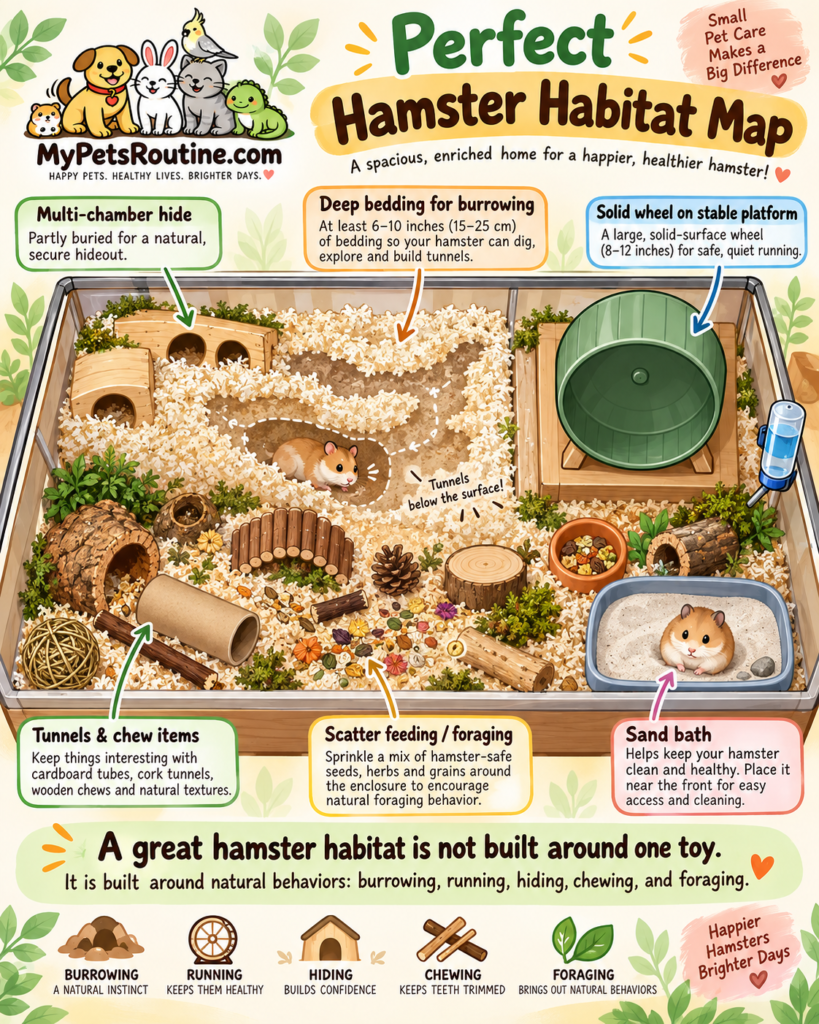
The Perfect Hamster Habitat Map
A strong hamster setup works like a tiny landscape. Each area has a purpose, and each purpose supports a natural behavior. This kind of layout is easier to understand when the enclosure is imagined from above.
| Habitat Zone | Best Location in the Enclosure | What to Include | Why It Matters |
|---|---|---|---|
| Deep burrow zone | One side or back section of the habitat | Deep unscented bedding, soft nesting material, partly buried tunnels | Supports digging, nesting, food stashing, and stress reduction |
| Wheel zone | Stable platform or lower-bedding area | Large solid-surface wheel with easy entry and exit | Provides safe daily exercise and prevents cramped running posture |
| Hide zone | Quiet corner or partly covered area | Multi-chamber hide, wooden house, ceramic hide, or cardboard shelter | Gives the hamster a secure sleeping and retreat space |
| Foraging zone | Across bedding and around safe objects | Scattered food, seed sprays, small chewable items | Encourages natural searching and exploration |
| Water and feeding zone | Easy-access area away from deep shifting bedding | Water bottle or bowl, small food dish if used, stable platform | Keeps essentials clean, reachable, and less likely to tip |
| Sand bath zone | Stable open area away from water | Hamster-safe sand in a shallow dish or container | Supports coat care and gives another natural texture |
| Chew and tunnel zone | Along pathways or partly buried | Cork tunnel, cardboard tubes, bendy bridge, untreated wooden chews | Adds enrichment, cover, and healthy chewing opportunities |
Common Habitat Mistakes New Hamster Owners Make
Many hamster problems begin with good intentions and poor product marketing. New owners often buy the cage that is labeled as a hamster starter kit, assuming it must be appropriate. Unfortunately, many starter kits are designed for convenience, shelf appeal, or low price rather than long-term welfare. They may include a tiny wheel, a shallow base, and a small plastic house, but they do not give the hamster the space and depth needed for normal behavior.
Another common mistake is treating bedding as something to minimize. Owners sometimes use only a thin layer because they want the cage to look tidy or because they worry deep bedding will smell. In reality, shallow bedding often becomes dirty faster and gives the hamster fewer ways to organize its space. Deep bedding, paired with spot cleaning, usually creates a more stable and comfortable habitat.
A third mistake is over-cleaning. Hamsters rely heavily on scent. When the entire enclosure is stripped, scrubbed, and replaced too often, the hamster may feel as though its home has disappeared. That stress can lead to frantic behavior, food hoarding, increased hiding, or defensive reactions. Cleanliness matters, but the goal is not to erase every familiar scent. A better rhythm is to remove soiled areas regularly while preserving clean bedding and nest structure whenever possible.
Owners also sometimes choose accessories based on cuteness rather than safety. A wheel with wire rungs, a tunnel too narrow for a Syrian hamster, a high platform without protection from falls, or a hide with sharp edges can turn a decorative cage into a risky one. The safest hamster setup is usually simple, spacious, deep, and thoughtfully arranged.
How a Better Habitat Changes Hamster Behavior
When a hamster moves from a cramped cage into a larger, deeper, more enriched enclosure, owners often notice subtle changes. The hamster may spend more time digging, building, and exploring. It may run on the wheel more naturally. It may become less frantic at the bars. It may begin using certain corners for toileting and other areas for sleeping or food storage. Some hamsters become easier to observe because they feel safe enough to come out on their own schedule.
This does not mean every hamster will suddenly become cuddly. Hamsters have individual personalities, and many prefer gentle observation over frequent handling. A proper habitat does not erase natural caution, but it does reduce unnecessary stress. It gives the hamster a fair chance to behave like a hamster rather than a trapped animal with too little to do.
For children, a good habitat also teaches a better lesson about pet ownership. It shows that small pets are not disposable or decorative. They are animals with specific needs. A child who learns to respect a hamster’s need for sleep, hiding, digging, and nighttime activity is learning empathy in a very practical way.
A Daily Habitat Check for Peace of Mind
Once the habitat is set up, daily care becomes much easier. Each day, the owner should quietly check that the water is clean and working, the wheel spins freely, the hamster has access to food, and no tunnels or objects have collapsed in a dangerous way. The toilet area can be spot cleaned as needed, especially if the hamster has chosen a consistent corner. Uneaten fresh food should be removed before it spoils. The enclosure should be checked for chew damage, loose lids, blocked entrances, or signs that the hamster has been trying to escape.
The hamster itself should also be observed. A healthy hamster should move normally, groom, eat, drink, store food, and show interest in its surroundings during active hours. Sudden changes in activity, appetite, breathing, posture, coat condition, or droppings deserve attention. Because hamsters are prey animals and often hide illness, owners should not wait too long to contact a veterinarian experienced with small mammals if something seems wrong.
Final Thoughts: Build the Habitat Around the Hamster, Not the Shelf Label
The best hamster habitat is not necessarily the one with the brightest plastic parts or the most complicated tube system. It is the one that gives the hamster enough space to move, enough bedding to burrow, a safe wheel to run, secure hides to retreat, and enough enrichment to make each night active and interesting. When the enclosure supports natural behavior, daily care becomes calmer for both the hamster and the owner.
A hamster may be small, but its needs are real. Choosing a spacious cage, deep bedding, a solid running wheel, safe hides, chew materials, and tunnels is not spoiling your pet. It is meeting the basic requirements of a healthy hamster life. For new owners, that shift in thinking makes all the difference. Instead of asking how little a hamster can live with, the better question is what kind of home allows a hamster to feel safe, active, and naturally busy.
A well-designed hamster habitat gives your pet more than a place to sleep. It gives them a world to explore.